
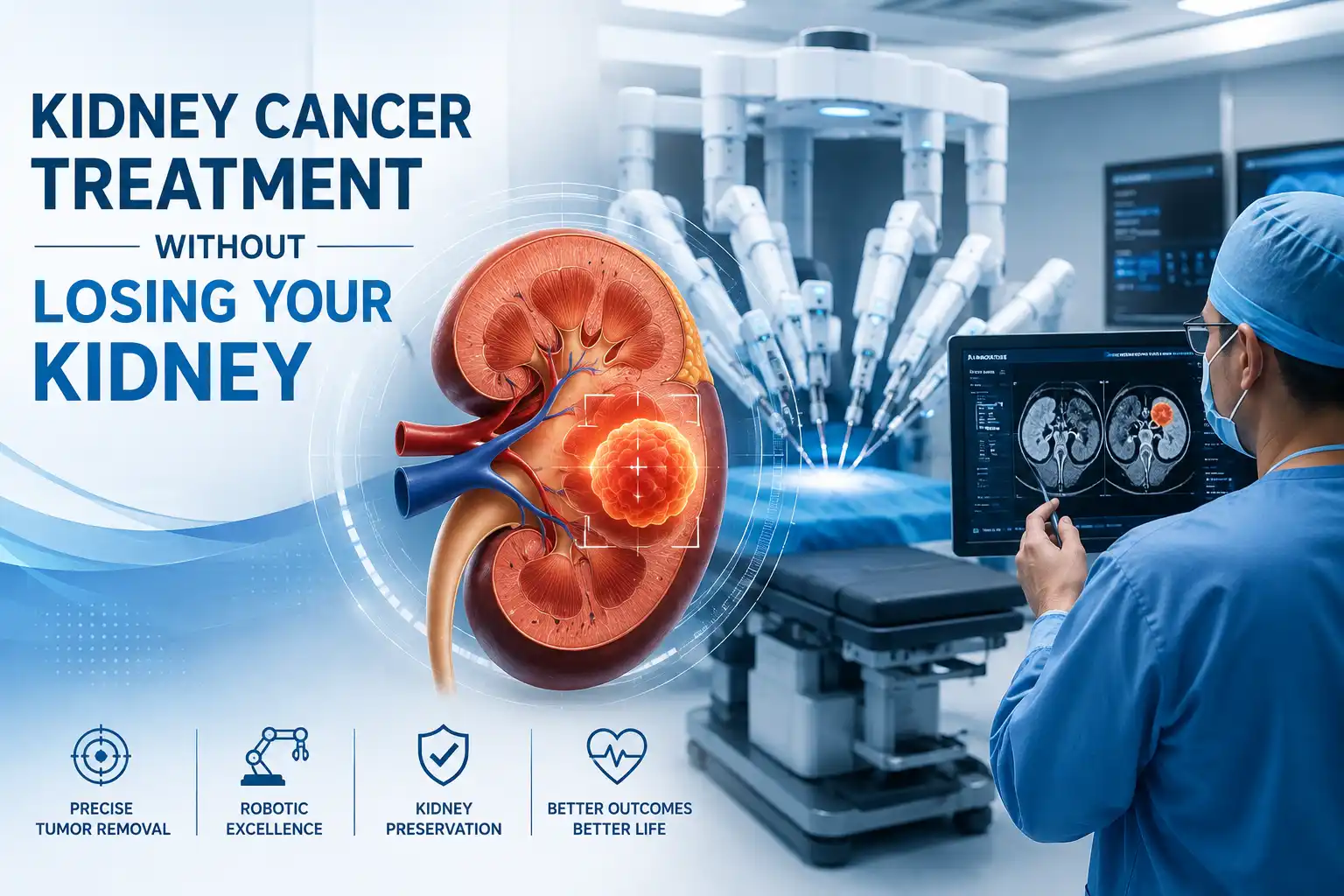
Hearing the words "you have kidney cancer" can be overwhelming. One of the first concerns many patients have is whether they will lose their entire kidney. Fortunately, advances in urologic oncology and robotic surgery have changed the way kidney cancer is treated.
Today, many kidney tumors can be removed while preserving the healthy part of the kidney. This approach, known as partial nephrectomy or kidney-sparing surgery, has become the preferred treatment for many patients with localized kidney cancer.
With modern robotic surgical systems, surgeons can remove the tumor with exceptional precision while maintaining as much normal kidney function as possible. For eligible patients, this means excellent cancer control, faster recovery, and a lower risk of long-term kidney-related complications.
In this article, we explore how kidney cancer is treated today, who may benefit from kidney-sparing surgery, and why robotic partial nephrectomy is transforming outcomes for patients worldwide.
Understanding Kidney Cancer
Kidney cancer develops when abnormal cells grow uncontrollably within the kidney. The most common type is renal cell carcinoma (RCC), accounting for the majority of kidney cancer diagnoses.
Kidney cancer often develops silently and may not cause symptoms in its early stages. Many tumors are discovered incidentally during scans performed for unrelated medical conditions.
Common Symptoms of Kidney Cancer
Patients may experience:
- Blood in urine (hematuria)
- Persistent flank pain
- A lump or swelling in the side
- Unexplained weight loss
- Fatigue
- Loss of appetite
- Fever without infection
Not all patients experience symptoms, which is why early detection is often accidental.
Why Was the Entire Kidney Traditionally Removed?
Historically, the standard treatment for kidney cancer was radical nephrectomy, which involves removing the entire kidney along with surrounding tissue.
At the time, surgeons believed that removing the entire kidney offered the best chance of eliminating cancer.
While radical nephrectomy remains necessary for some patients, advances in imaging and surgical technology have shown that many tumors can be safely removed while preserving healthy kidney tissue.
This shift has significantly improved long-term outcomes for patients.
What Is Partial Nephrectomy?
Partial nephrectomy is a surgical procedure in which only the cancerous tumor and a small margin of surrounding tissue are removed.
The remaining healthy portion of the kidney is preserved.
This allows patients to maintain kidney function while still achieving excellent cancer control.
Goals of Partial Nephrectomy
- Completely remove the tumor
- Preserve healthy kidney tissue
- Maintain long-term kidney function
- Reduce future health complications
- Achieve outcomes comparable to radical nephrectomy
Today, partial nephrectomy is considered the preferred treatment whenever technically feasible.
Why Preserving Kidney Function Matters
The kidneys play a vital role in filtering waste, regulating blood pressure, maintaining fluid balance, and supporting overall health.
Removing an entire kidney may increase the risk of:
Chronic Kidney Disease
Reduced kidney function may lead to long-term health issues.
Cardiovascular Disease
Patients with impaired kidney function often have higher risks of heart disease and stroke.
Hypertension
Loss of kidney function can contribute to elevated blood pressure.
Reduced Quality of Life
Maintaining healthy kidney tissue supports better long-term well-being.
For these reasons, preserving kidney function whenever possible has become a major goal of modern kidney cancer treatment.
Diagnosed With a Kidney Tumor?
Many kidney cancers can now be treated without removing the entire kidney.
Consult Dr. Vivek Venkat to learn whether robotic kidney-sparing surgery is right for you.
✓ Robotic Partial Nephrectomy
✓ Kidney Cancer Treatment
✓ Second Opinions
✓ Personalized Surgical Planning
What Is Robotic Partial Nephrectomy?
Robotic partial nephrectomy is a minimally invasive procedure performed using a robotic-assisted surgical platform.
The robotic system does not perform the surgery independently. Every movement is controlled by the surgeon.
The technology enhances surgical precision by providing:
- Magnified 3D visualization
- Greater dexterity
- Enhanced control
- Improved precision around critical structures
This allows surgeons to remove tumors while preserving healthy kidney tissue.
Advantages of Robotic Partial Nephrectomy
Smaller Incisions
Tiny incisions result in less tissue trauma and reduced scarring.
Less Pain
Patients typically experience less postoperative discomfort.
Reduced Blood Loss
Enhanced precision helps minimize bleeding during surgery.
Faster Recovery
Many patients return to normal activities sooner compared to traditional open surgery.
Better Cosmetic Outcomes
Smaller incisions leave minimal visible scarring.
Preservation of Kidney Function
Maintaining healthy kidney tissue helps support long-term health.
Who Is a Candidate for Kidney-Sparing Surgery?
Many patients with localized kidney tumors may qualify for partial nephrectomy.
Potential candidates include:
Patients With Small Kidney Tumors
Tumors smaller than 4 cm are often excellent candidates.
Patients With Medium-Sized Tumors
Many tumors between 4–7 cm may also be suitable.
Patients With a Solitary Kidney
Preserving kidney function becomes especially important when only one kidney is present.
Younger Patients
Long-term kidney preservation provides significant benefits over a lifetime.
Each patient requires individualized evaluation before treatment recommendations are made.
What Happens During Robotic Partial Nephrectomy?
The procedure generally follows several steps:
Preoperative Planning
Advanced imaging identifies tumor size, location, and complexity.
Tumor Identification
The surgeon carefully isolates the tumor.
Tumor Removal
Only the cancerous portion of the kidney is removed.
Reconstruction
The remaining kidney tissue is reconstructed to restore normal anatomy.
Recovery
Patients are closely monitored before discharge.
The robotic platform helps perform these steps with exceptional accuracy.
Recovery After Surgery
Recovery varies depending on tumor complexity and individual health factors.
Typical Recovery Timeline
Hospital Stay: 1–3 days
Walking: Within 24 hours
Return to Desk Work: 2–3 weeks
Physical Activity: 4–6 weeks
Follow-Up Imaging: Regular scans to monitor recovery
Most patients are pleasantly surprised by how quickly they recover after robotic surgery.
Latest Advances in Kidney Cancer Treatment in 2026
Technology continues to improve kidney cancer care.
AI-Assisted Imaging
Artificial intelligence helps identify and characterize kidney tumors with greater accuracy.
3D Surgical Planning
Detailed 3D reconstructions help surgeons plan complex procedures.
Advanced Robotic Platforms
Modern robotic systems provide improved precision and surgical control.
Personalized Treatment Strategies
Treatment plans are increasingly tailored to individual patient characteristics and tumor biology.
These innovations are helping improve outcomes while preserving organ function.
When Is Complete Kidney Removal Still Necessary?
Although many tumors can be treated with partial nephrectomy, radical nephrectomy may still be recommended in some situations.
Examples include:
- Very large tumors
- Tumors involving major blood vessels
- Extensive cancer spread within the kidney
- Complex anatomy preventing safe tumor removal
The choice depends on achieving the best balance between cancer control and kidney preservation.
Conclusion
A diagnosis of kidney cancer no longer automatically means losing an entire kidney. Thanks to advances in robotic surgery and kidney-sparing techniques, many patients can undergo successful tumor removal while preserving healthy kidney function.
Robotic partial nephrectomy has become a preferred treatment option because it combines excellent cancer control with the benefits of minimally invasive surgery. Patients often experience less pain, faster recovery, and better long-term kidney health.
If you have been diagnosed with a kidney tumor, consulting an experienced uro-oncology specialist such as Dr. Vivek Venkat can help you understand your treatment options and determine whether kidney-sparing surgery is appropriate for your condition.
Frequently Asked Questions
Can kidney cancer be treated without removing the entire kidney?
Yes. Many localized kidney tumors can be treated with partial nephrectomy, allowing preservation of healthy kidney tissue.
Is partial nephrectomy as effective as removing the whole kidney?
For many appropriately selected patients, partial nephrectomy provides excellent cancer control while preserving kidney function.
What size kidney tumor can be treated with partial nephrectomy?
Many tumors up to 7 cm may be suitable, depending on their location and complexity.
Is robotic partial nephrectomy safe?
Yes. It is considered a safe and effective procedure when performed by an experienced robotic surgeon.
How long does recovery take after robotic kidney surgery?
Most patients return to normal daily activities within a few weeks, although complete recovery varies between individuals.
Will I need dialysis after surgery?
Most patients maintain adequate kidney function and do not require dialysis following partial nephrectomy.
Can kidney cancer come back after surgery?
There is always a possibility of recurrence, which is why regular follow-up imaging and monitoring are important.
Why should I choose a robotic approach?
Robotic surgery offers smaller incisions, reduced pain, faster recovery, less blood loss, and excellent precision during tumor removal.